


One of the design concepts in Bitcoin I found hardest to understand was the idea of unspent transaction outputs (UTXOs). I will be writing an article on this in the future, explaining it further, but in this video, I talk about the core idea that you have to grasp before the rest makes sense.
Bitcoin balances are not tracked through having some kind of table with owners in a first column of data, and balances in a second column.
Instead, bitcoins are kind of floating around between blockchain addresses in unclaimed transactions, which are called UTXOs.
Whenever you want to spend some bitcoin (that is, transfer them to an address), you have to prove that you can claim one of these unclaimed transactions by proving you have the knowledge to do so, for example, by providing a digital signature, and then add on a new transaction that the recipient can claim at some point in the future.
This means that to find the balance of an address, you have to construct the balance by scanning through all the UTXOs in the entire blockchain, looking for ones that could be claimed by that address.
Nakamoto explains this with the following diagram:
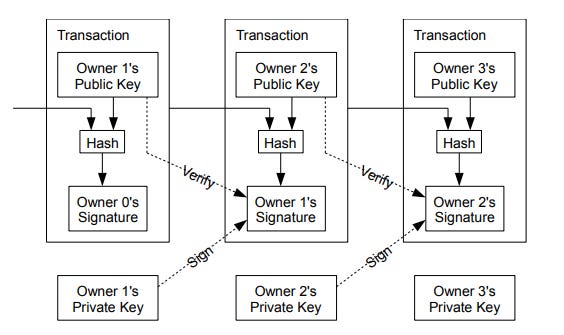
I never found this particularly clear, because there are so many components to it.


